
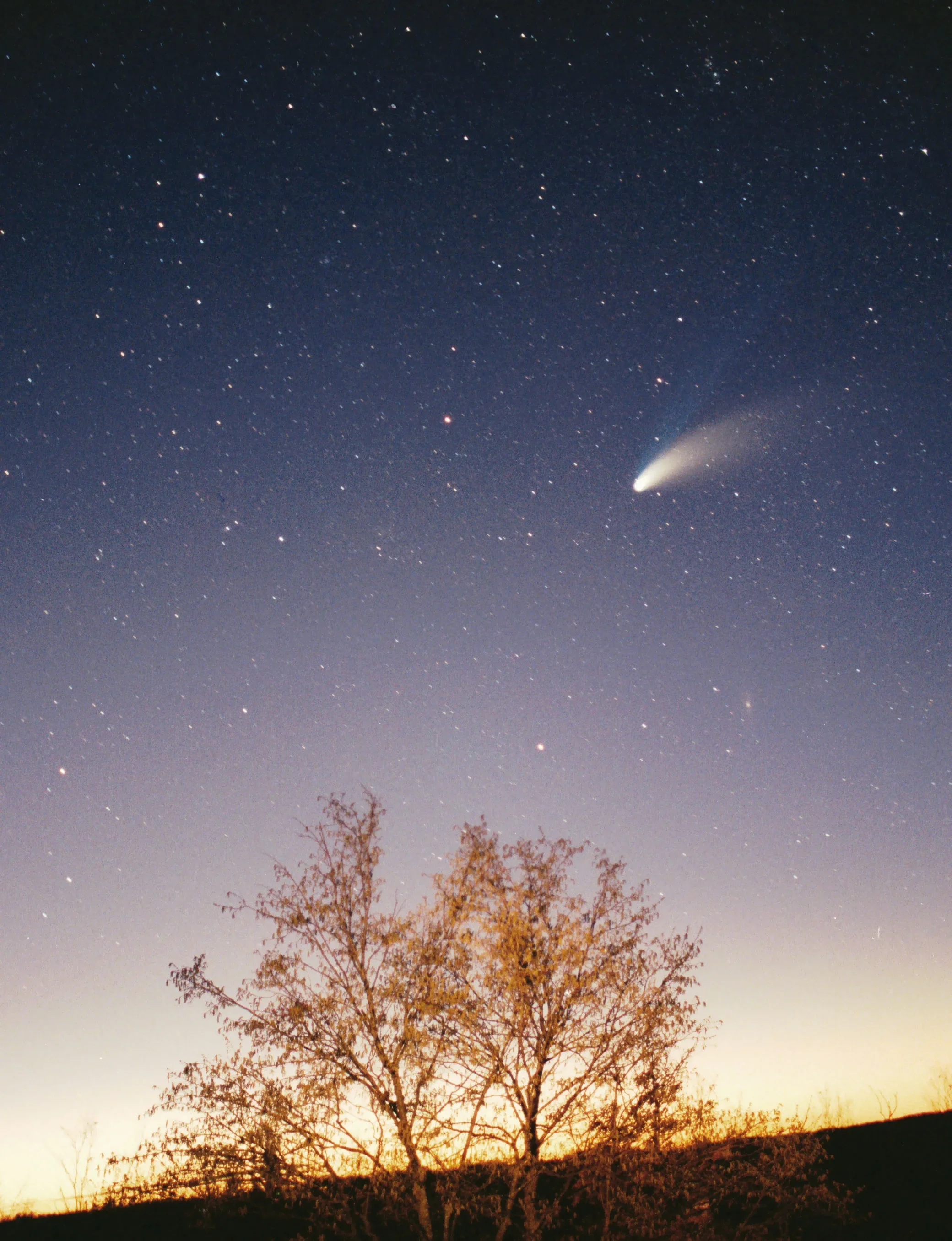
In April, a guest from the outermost reaches of the Solar System appeared in the morning sky, and there is less and less time left for observers in the Northern Hemisphere to catch a glimpse of it. Comet C/2025 R3 (Pan-STARRS) – a long-period comet from the Oort cloud with an orbital period of about 170,000 years – was registered as visible to the naked eye on April 11 at an approximate magnitude of 5.1, according to observations cited in its "Wikipedia" article. The celestial body, first discovered on September 8, 2025, with the "Pan-STARRS" survey telescope at the Haleakala Observatory on Hawaii, is slowly but surely increasing in brightness as it approaches the inner part of the Solar System.
A narrow morning observation window
Currently, the comet is moving slowly through the constellation Pegasus and can be seen low above the eastern horizon about an hour and a half before sunrise. At this stage, the most suitable instrument for amateur astronomers is a pair of binoculars, but forecasts indicate that C/2025 R3 may reach a magnitude of about +3 or even brighter as it approaches perihelion on April 19, when it will pass at a distance of approximately 0.5 astronomical units from the Sun. The boldest models even allow for a peak brightness of around -0.5 magnitude.
"If you want to see the comet, the best chance is within the next week or so, while it continues to increase in brightness, but remains observable in a relatively dark sky," says Nick James, head of the comet section of the British Astronomical Association, for "Space.com". "You'll need to get up early, a few hours before sunrise, and have a well-exposed, unobstructed eastern horizon".
Key dates and what's next
Several upcoming morning configurations deserve special attention. On April 14, a thin crescent of the waning Moon will appear near Mercury low in the east, adding a picturesque background to the comet's field. In the period from April 17 to 19, around the new moon, the sky will be as dark as possible – just when C/2025 R3 is expected to approach its peak brightness. After passing through perihelion, the comet will head towards the area of the sky closer to the Sun and will gradually become more difficult to observe from the northern latitudes.
On April 26, C/2025 R3 will also reach its closest point to Earth – approximately 0.49 astronomical units – but at this time it will be only a few degrees from the Sun, which will greatly complicate observations. Observers in the Southern Hemisphere will get their chance in late April and May, when the comet will reappear in the evening sky, this time low above the western horizon after sunset.
Astronomers note that C/2025 R3 is moving on a hyperbolic trajectory and, after the current passage, will most likely be definitively ejected from the gravitational influence of the Solar System. This means that the phenomenon is not just an event that repeats once every 170,000 years, but probably the last opportunity for humanity to see this comet at all – a single window on a geological and cosmic scale.






Comments (6)
Ахахах, комета де! 170 хилади години... значи нашите предци са си гледали същата тая светилка докато са си живели в пещерите и са си гонили мамутите. И сега ние трябва да се мъчим да
Абе, хах, 170 хиляди години! Добре де, много е впечатляващо, наистина. Ама виж сега, все едно ни казват "ела да видиш нещо невероятно, което повечето хора няма да видят никога". Звучи малко... драматично. 😂 Все пак, ще се опитам да я зърна, ама не съм оптимист - с това времето дето е… Абе, поне да беше ясно как точно трябва да гледаме, да не се правя
ебати! 170 хиляди години?! леле мале, направо ми се изправя ко 😜
Абе хора, сериозно ли? 170 хиляди години... Малко е страшно да си представиш колко неща са се случвали на Земята от тогава! Преди човека дори! Представям си нашите предци, докато са палили огън и са гледали тая комета – какъв е бил животът им, кво са мислили... А сега ние, с нашите технологии
браво, браво! уау, 170 хилади години?! сериозно ли е това? 🤯 няма да повярвам докато не я видя с моите очи! дано времето ни позволи да я зърнем всички, че наистина е уникално събитие. иначе, представям си как ще изглежда снимка от космоса – невероятно! 👍🏼🇪🇺 българия и европа са в челните