
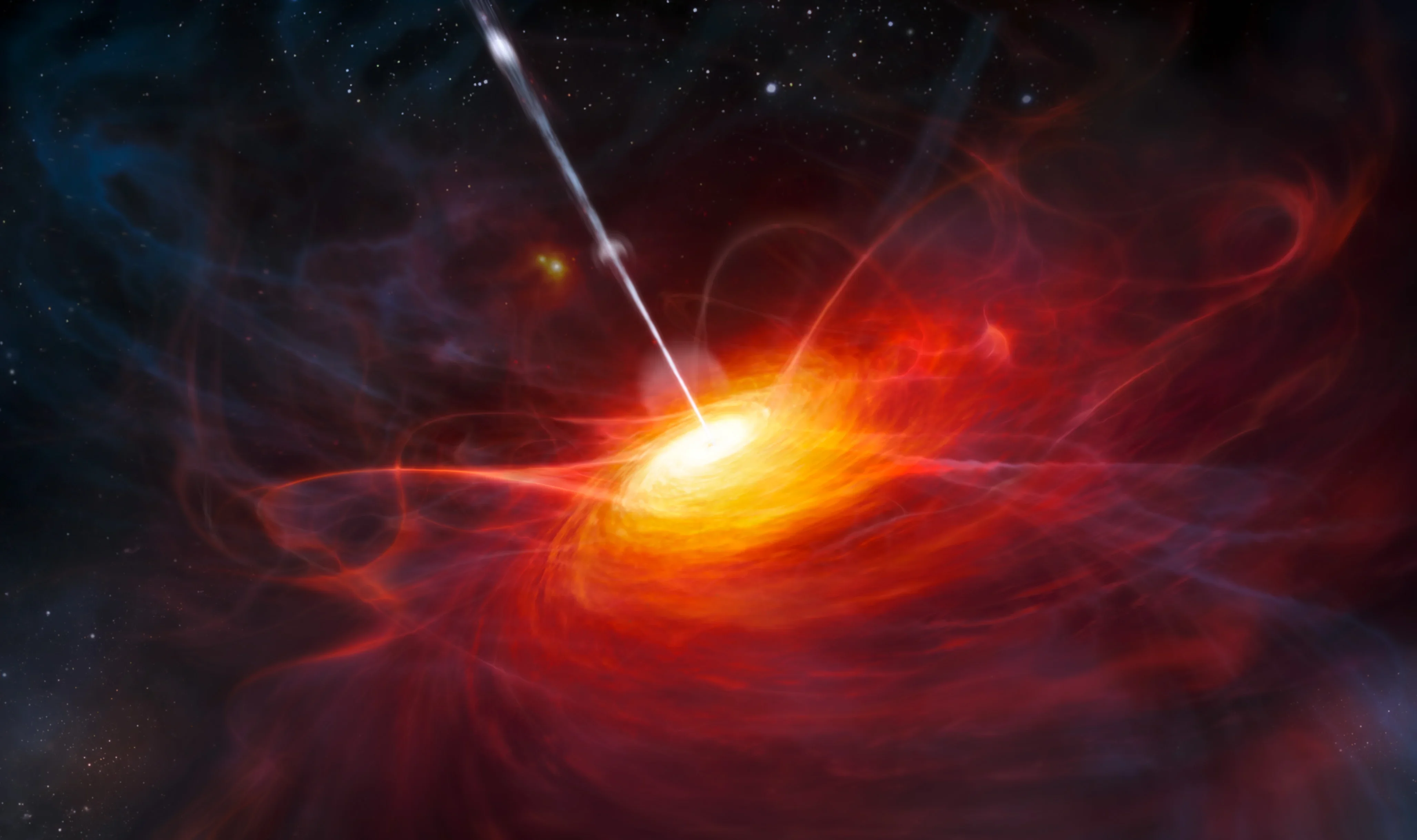
The European Space Agency's "Euclid" space telescope has discovered "31 new, previously unknown quasars" in the early Universe, including two objects that set a new record as the most ancient observed quasars in the history of space exploration. The results, published on July 6 in the journal "Astronomy & Astrophysics", more than "double" the number of known quasars that existed during the first "770 million years" of the Universe's life and deepen the long-standing mystery of how supermassive black holes managed to grow to colossal sizes so soon after the Big Bang.
Two record-breaking quasars from the "childhood" of the Universe
The two record-breaking quasars, designated as "EUCL J172902.75+641018.1" and "EUCL J125308.55+705432.3", have a "redshift of 7.77 and 7.69" respectively. Thus, they surpass the previous record, set in 2021 by a quasar with a redshift of "7.64". Both objects are located at a distance of "over 13 billion light-years" and were formed when the age of the Universe was about "670 million years" – just about "5% of its current age".
"These early quasars belong to the infancy of the Universe", says "Daming Jiang" of Leiden University, lead author of the discovery paper. "By finding and studying them, we can better understand how these colossal systems formed and grew so rapidly — this is one of the greatest mysteries of astrophysics."
"Census" of the cosmic dawn
The discovery adds "12 new quasars" with a redshift of "7 and higher", which corresponds to the period of the first "770 million years" of the Universe's existence. To discover the first approximately "10" similar quasars, it took astronomers more than "ten years"; "Euclid" achieves the same result "in just one year of observations".
"The 'Euclid' team has for the first time conducted a true 'census' of quasars at the dawn of the Universe", states "Antonio La Marca", a research fellow at ESA. "This is a big step toward understanding these amazing objects at a more fundamental level."
The quasars discovered by "Euclid" belong to the era of "reionization" – a transition period in which the cosmos shifted from a state of "cold darkness" to a state filled with "light". It is precisely this phase that laid the foundation for the formation of all the cosmic structures we observe today.
Follow-up observations with the "Subaru" telescope and other ground-based observatories show that one of the most distant quasars is located inside a "dusty star-forming galaxy". This provides key insights into the environment surrounding early supermassive black holes and the connection between their growth and vigorous star formation.
Unmatched capabilities of "Euclid"
"Euclid", launched in "July 2023", combines a "wide sky coverage" with "deep infrared observation from space". This combination allows for the detection of "very faint and extremely distant objects" significantly more efficiently than with ground-based surveys.
All 31 quasars were identified within the wide survey of "Euclid", which will eventually cover "more than one third of the sky". Thus, the telescope is becoming a key tool for systematically mapping the earliest bright sources of light in the cosmos.
"'Euclid's' capabilities are unparalleled", states the project's scientific lead at ESA, "Valeria Pettorino". "The telescope combines a large survey area, depth, sharp imaging, and unique infrared vision in space in such a way that we can isolate rare, extremely distant objects much more efficiently than before."
The mystery of supermassive black holes remains open
Despite the impressive progress in discovering early quasars, the main scientific question remains open: how the supermassive black holes that stand at the center of these objects managed to reach "billions of solar masses" within a few hundred million years after the Big Bang.
The new data from "Euclid" does not provide a definitive answer, but it provides a sufficiently rich "statistical base" to test various theories – from the formation of "massive primordial black holes" to scenarios of "extremely rapid growth" via accretion and mergers. Astronomers expect that as the "Euclid" survey expands, the number of known early quasars will continue to grow and will allow for an even more complete picture of the cosmic dawn.

Comments (14)
А бе, наистина ли са толкова стари тия квазари? Как е възможно да растанат толко бър
абе, ей... интересно е това с "евклид"-а, наистина. винаги ме е кефило да чета за космоса, макар че разбирам само половината от тия работи. добре де, 31 нови квазара - добре, ама какво ще кажат сега тия физиците? нали
Хм, значи много светлина е имало преди… Странно е, честно казано. И как са
Абе, харесва ми! Българите участват ли в тоя проект? Ако да - браво на
Уау, ако е! ВСЕ пак си е голям пробив за науката