

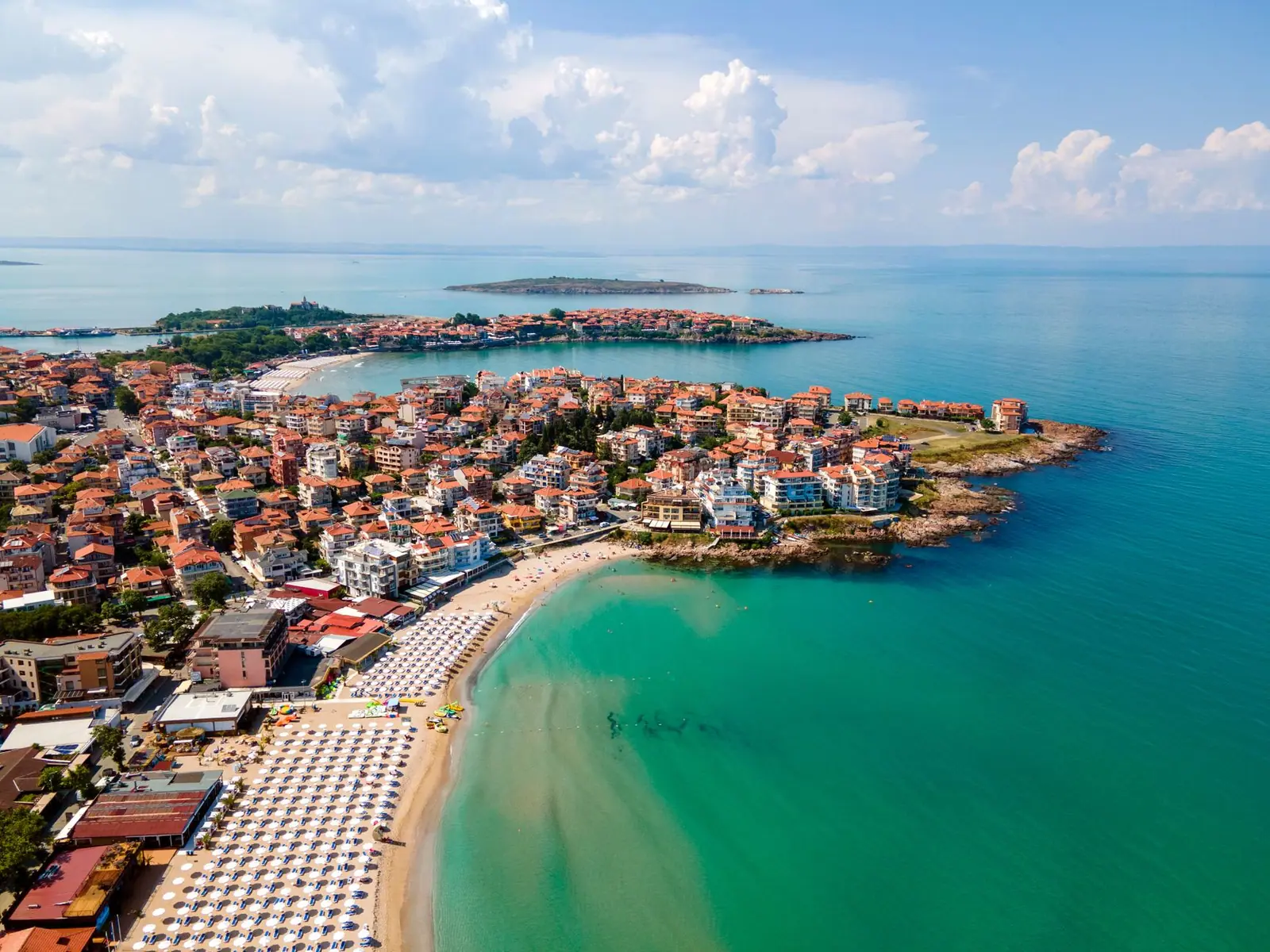
Rumen Draganov, director of the Institute for Tourism Analysis and Assessment, predicts that Eurovision in May 2027 will bring more than 80,000 visitors to Burgas and the region. Hotels in Burgas and Pomorie are already listing rooms for the contest at prices many times higher than usual.
This report follows our earlier story on the Culture Ministry's accompanying programme for Eurovision 2027 in Burgas, which minister Evtim Miloshev said has its own line in the ministry's 2027 budget.
Draganov says half of the visitors will be foreigners and the other half will come from Bulgaria. The contest hall holds 80,000 people.
At a five-star hotel in Pomorie, six nights with breakfast in a double room in May cost €1,100, according to its official website. The same room for contest week, 10 to 16 May, costs €3,750.
Another place to stay in Pomorie asks €400 for a week in May and €2,800 during Eurovision, which is 7 times more. In Burgas, hotels that usually charge €100 a night have raised prices several times over. In Sunny Beach, a five-star hotel is for now offering a double room for the contest days at €76.
Draganov expects a night to cost about €100 a room. He says the contest audience is mostly young people without much money, who will look for cheap rooms. Hotels that want triple and quadruple profits will be left with empty rooms because of the heavy competition, he says. He gave Liverpool as an example, where hotels with inflated prices ended up without guests.
Plamen Kopchev, chairman of the Sunny Beach Owners' Union, believes a night for €1,000 is not possible with so much competition, because there are hundreds of hotels around Burgas. Prices will be normal, as in previous years, and the most expensive may come close to peak-season levels, but no more. For now, each hotel sets its own price.
In Sunny Beach, about 70% of hotels are being renovated. Kopchev said some of the work is the usual post-season repairs, some is being done specially for Eurovision, and some hotels are going for more luxurious interiors for contest guests.
Most hotels in the resort will open for Easter, and quite a few will do so in the last week of April. Many will be open to tourists from 1 May. It is not yet known how many will take guests at the end of April and how many only in early May.
Thousands of rooms have already been booked by fans from around the world through international booking platforms. Many hotels have 20 to 40% of their capacity booked for May. In Kopchev's hotel, more than 100 of 320 rooms have been booked for Eurovision through Booking.com. The usual stay is 3–4 days, at most a week.
Kopchev believes Burgas hosting the contest has already drawn the attention of fans worldwide. He says current bookings are provisional, because there may be cancellations or bookings for longer periods.
Draganov expects some guests to arrive before the contest for entertainment and culture, and others to stay on afterwards to see Burgas and the region. He says there should therefore be events before and after Eurovision. In 2027, the Black Sea coast could attract more visitors outside the main season with cultural and entertainment programmes, he says.
A calculator on the website bulgaria-eurovision.com estimates that a trip to Burgas for the contest costs between €490 and €1,080 per person for a fan travelling from Sofia. The sum covers a final ticket, fuel, accommodation, food and drinks, and city transport. The final price depends on the ticket and seat in the hall, and on the hotel category. The same website lets users compare usual and current prices for a night's stay.
Hoteliers in Sunny Beach will discuss room prices for the contest at a working meeting in mid-November.

Comments (1)
Седемстотин и шестдесет евро? И това само за Слънчев браг ли е? Не беше ли Поморие по-скъпо, според новината?